Why Quality You Can Measure Matters in Medical CNC Machining
In medical component manufacturing, precision is essential for patient safety, device reliability, and regulatory compliance. Even the smallest deviation can affect how an implant or device performs in the human body. For medical device manufacturers, engineers, and quality managers across Colorado’s Front Range and beyond, there is little margin for error.
At Advanced Precision Machining (APM), we understand that the components we produce may be used in critical medical applications. Our processes are built around measurable, documented, and repeatable quality standards to ensure every part meets its required specifications. Rather than relying on visual inspection alone, we verify performance through precise measurement and rigorous inspection.
For engineers, buyers, and quality managers looking for a machining partner that understands the demands of medical manufacturing, our advanced metrology and inspection processes provide the confidence that every component meets strict quality expectations.
Ready to learn more about the APM difference? Contact us to discuss your medical CNC machining requirements.

What Metrology Means in Medical CNC Machining
Metrology, the science of measurement, ensures that medical CNC machined parts meet exact specifications. Medical devices often require tolerances measured in microns, meaning every feature must be produced and verified with extreme accuracy.
At APM, metrology is built into our workflow from the very beginning. When we receive a new project, our team reviews the drawings and specifications in detail, identifying all critical dimensions, geometric tolerances, and surface finish requirements. We then develop a measurement plan that ensures every feature can be verified, not just assumed.
Why is this important? In medical machining, even small deviations can affect performance and safety. A slightly rougher surface finish on an implant may increase the risk of bacterial growth, while a feature that falls outside tolerance on a surgical instrument could affect how it functions. To prevent these issues, we verify dimensional accuracy, surface finish, geometric tolerances, and material consistency throughout the manufacturing process.
Metrology also supports regulatory compliance and audit readiness. When an auditor or OEM asks for proof that a part meets requirements, we can provide digital inspection reports, calibration records, and traceability documentation instantly. This is the level of transparency and accountability our clients have come to expect.
The Difference Between Measurement and Inspection
While measurement and inspection are often mentioned together, they serve distinct but complementary roles in quality assurance. Measurement is the process of collecting data, whether it’s the diameter of a hole, the flatness of a surface, or the roughness of an edge. Inspection, on the other hand, is the act of evaluating whether those measurements conform to the specified requirements.
At APM, both measurement and inspection are integrated throughout our workflow. In medical components manufacturing, even small variations can affect device performance, which is why we verify features at multiple stages of production. For example, when producing a batch of orthopedic implant components, we conduct in-process measurements at defined intervals rather than only checking the first and last parts of the machine. Each data point is compared to the required tolerances, and our inspection process reviews the results to identify deviations before they affect downstream operations.
This proactive approach reduces the risk of costly rework, scrap, or field failures. By catching issues early, we protect our clients from downstream headaches and help maintain their reputation for quality.
For example, during a recent project, in-process inspection detected gradual tool wear that began pushing a critical dimension toward its tolerance limit. Because the change was identified early, our team adjusted the machining process and recalibrated the tooling, allowing production to continue without interruption.
Advanced Inspection Technologies in Medical Machining
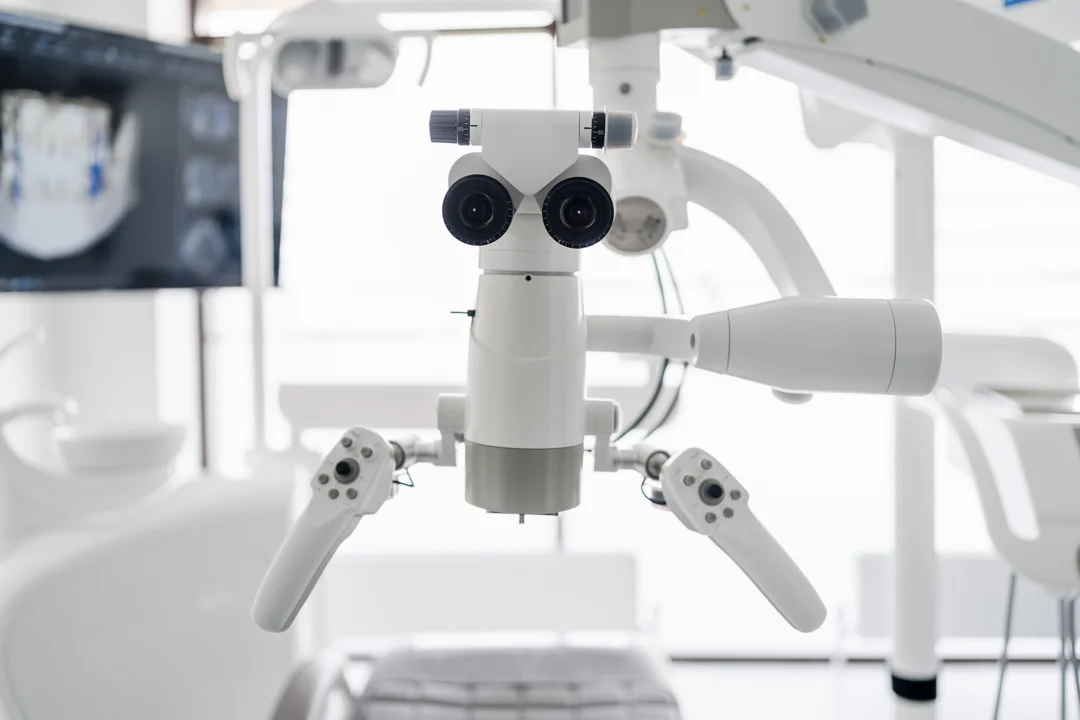
Modern medical components require more than basic measurement tools. At APM, we’ve invested in a suite of advanced inspection technologies to ensure every part meets the highest standards.
Our core inspection technologies include:
- Coordinate Measuring Machines (CMMs):
- Achieve micron-level accuracy for complex geometries.
- Map parts in three dimensions to verify simple and intricate features.
- Used both at the start of production and for in-process checks.
- Optical, Laser, and Vision Inspection Systems:
- Measure micro-features and verify surface finishes non-destructively.
- Inspect features like etched markings, micro-holes, and delicate coatings.
- Ideal for parts with fine details or delicate surfaces.
- Surface Roughness Testers, Micrometers, and Calibrated Tools:
- Quantitatively assess surface finish quality.
- Ensure every dimension is within specification.
- All tools are regularly calibrated for traceability.
- Data Integration and Digital Reporting:
- Inspection data is digitally logged into our quality management system.
- Enables trend analysis, rapid documentation retrieval, and transparent reporting for clients and auditors.
This comprehensive technology suite allows us to provide not just parts, but complete confidence in every component we deliver.
Inspection Workflow: From First Article to Final Verification
Our inspection workflow is designed to ensure that every part meets requirements from the very first piece to the last. Here’s how we do it:
- First Article Inspection (FAI) and Process Validation:
- Conducted before any production run.
- The first part is measured and inspected under real production conditions.
- All critical dimensions and features are verified.
- Engineers, machinists, and quality professionals collaborate to review results and adjust parameters.
- In-Process and Statistical Process Control (SPC):
- Quality assurance continues throughout production.
- In-process inspections at defined intervals using SPC techniques.
- Control charts and statistical analysis detect trends and sources of variation.
- Early detection allows for corrective action before issues escalate.
- Final Inspection and Documentation:
- Each batch undergoes a final inspection before shipment.
- Dimensional checks, surface finish verification, and visual inspection for cosmetic criteria.
- Comprehensive documentation, inspection reports, certificates of compliance, and traceability records are provided to clients.
This rigorous process gives our clients peace of mind, knowing that every part delivered is fully verified and documented.
Traceability, Documentation, and Regulatory Compliance
Traceability is a cornerstone of compliance in medical manufacturing. At APM, we ensure meticulous documentation and record-keeping at every stage. Here’s what our process looks like:
- Material Traceability:
- Every material lot is assigned a unique identifier.
- Each part can be traced back to its raw material source.
- Production and Inspection Records:
- Batch numbers link each component to its production run and inspection data.
- Operator records are maintained for accountability.
- Digital Record-Keeping:
- All records are digitally stored for rapid retrieval.
- Supports compliance with ISO 13485, FDA 21 CFR Part 820, and other standards.
- Audit-Ready Documentation:
- Certificates of compliance, inspection reports, and calibration records are always available.
- Our documentation stands up to the most rigorous audits, providing complete transparency.
If a question ever arises, whether from a client, auditor, or regulatory agency, we can provide comprehensive, transparent records in minutes.
How Inspection Data Drives Quality, Risk Reduction, and Cost Control
Inspection data is a powerful tool for continuous improvement. By analyzing trends in measurement data, we can identify opportunities for process optimization, tighter tolerances, and even design improvements.
For example, during a recent prototype-to-production transition, our analysis of in-process inspection data revealed a recurring dimensional variation tied to a specific machining operation. By working with the client’s engineering team, we recommended a minor design adjustment and a change in toolpath strategy. The result was improved yield, reduced scrap, and faster production ramp-up.
This data-driven approach helps reduce risk while also supporting better cost control. By catching potential issues early, we minimize the risk of expensive rework or recalls, saving our clients time and money.
Collaboration: Engineers, Machinists, and Quality – A Colorado Advantage
Quality in medical CNC machining is a collaborative effort. At APM, we believe that the best results come from close cooperation between engineers, machinists, and quality professionals.
From the initial design review to the final shipment, our teams work together to identify potential challenges, optimize manufacturability, and ensure every requirement is met. We encourage open communication, early DFM feedback, and joint problem-solving.
For clients in Colorado and the Front Range, this collaborative approach offers tangible benefits. Local partners can visit our facility, participate in process reviews, and see our inspection processes firsthand. This level of transparency and accessibility builds trust and strengthens long-term partnerships.
If you’re a local OEM, engineer, or quality manager, we invite you to schedule a plant tour or consultation. Experience the difference that collaboration and accountability can make.
What Sets APM Apart: Beyond “Standard” Medical CNC Machining
Medical CNC machining requires more than tight tolerances. It demands documented precision, reliable inspection, and processes that stand up to scrutiny. That’s exactly how Advanced Precision Machining (APM) operates.
At APM, we’ve invested heavily in the systems that make that level of consistency possible. Our facility is equipped with advanced metrology technology, supported by a structured inspection workflow and documentation practices designed for traceability and accountability.
This approach allows us to verify every critical dimension and maintain the level of repeatability that medical components demand. Our clients rely on that consistency because they know our process doesn’t stop at machining, it extends through measurement, validation, and clear documentation.
“If you can’t measure it, you can’t trust it.” At APM, this principle guides everything we do.
Frequently Asked Questions (FAQ)
- What certifications does APM hold for medical CNC machining?
- How does APM ensure traceability and regulatory compliance?
- What inspection equipment does APM use?
- Can APM support rapid prototyping for medical devices?
- How does APM collaborate with client engineering teams?
- What is APM’s geographic service area?
We maintain compliance with ISO 13485, FDA 21 CFR Part 820, and other industry standards to ensure the highest level of quality and traceability.
Through rigorous documentation, batch tracking, and digital record-keeping, we provide full traceability from raw material to finished part.
Our facility is equipped with CMMs, optical and laser systems, surface roughness testers, and a comprehensive suite of calibrated precision tools.
Absolutely. Our flexible processes are designed to support both rapid prototyping and full-scale production, ensuring speed without sacrificing quality.
We offer early DFM input, transparent communication, and open access for site visits and project reviews, ensuring alignment at every stage.
We proudly serve clients in Longmont, Boulder, Denver, Fort Collins, and throughout Colorado’s Front Range.
Have more questions? Contact us for personalized answers.
Partner with Colorado’s Medical CNC Machining Experts
Precision in medical CNC machining is not just about cutting metal. It’s about delivering parts that are verified, documented, and repeatable. At Advanced Precision Machining, we combine cutting-edge technology with a culture of transparency and continuous improvement.
Ready to get started?
- Book a consultation with our machining experts
- Schedule a plant tour to see our metrology and inspection processes in action
Explore more resources:
- Read our complete guide to Medical CNC Machining in Colorado
- Learn more about our services
Let’s raise the standard for medical machining together. Precision you can prove, quality you can trust!
by Gerry Dillon
Gerry Dillon is a co-founder, current owner and certified CNC machinist at Advanced Precision Machining (APM), a full-service machine shop located in Longmont, Colorado. Gerry has over 30 years of precision milling and machining experience under his belt.