Imagine holding your next breakthrough in your hands, weeks sooner than you thought possible. That’s the power of rapid prototyping for scientific instrument machining. Here at Advanced Precision Machining (APM), we help innovators across Colorado’s Front Range and beyond move from concept to reality with speed, accuracy, and confidence.
Our approach is simple: bring your scientific ideas to life quickly, validate them in the real world, and set the stage for seamless production. If you’re ready to see your vision take shape, without losing months to redesign, contact us today. We’re here to accelerate your next scientific leap.

Why Rapid Prototyping is Essential in Scientific Instrument Development
Bringing a new scientific instrument to market isn’t just about having a good idea, it’s about reducing risk at every step. Prototyping isn’t an “extra”, it’s how our Colorado machine shop helps you avoid costly redesigns, production delays, and missed opportunities.
Why does prototyping matter so much?
- Spot Issues Early: Prototypes reveal mechanical, tolerance-stack, and assembly challenges before they become expensive problems.
- Validate in Reality: There’s no substitute for real-world testing. A prototype lets you prove functionality, beyond what CAD models can predict.
- Align Your Team: A tangible part helps stakeholders, investors, and internal teams see, touch, and believe in your project.
As APM owner Gerry Dillon states, “There’s nothing like holding the real thing in your hand. That’s when you know you’re on the right track. It’s not just about the part, it’s about clarity, confidence, and momentum.”
The APM Approach: From Concept to Production Under One Roof
At APM, we’ve built our reputation on being more than just a machine shop, we’re your full-lifecycle partner for scientific instrument machining. From your first sketch to your hundredth production run, we’re with you every step of the way.
Here’s how we do it:
- Consultation & Design: We listen first, understanding your goals, constraints, and what “success” looks like for your team.
- Rapid Prototyping: Our expert machinists translate your CAD files into real, functional parts, fast.
- Inspection & Validation: Every prototype undergoes rigorous inspection to ensure it meets your exact specifications.
- Scaling to Production: Once your prototype is dialed in, we seamlessly transition to production, no lost knowledge, no do-overs.
We believe that reliability is a feature. On-time delivery and consistent quality aren’t just promises, they’re how we help you sleep at night. Our ISO-compliant machine shop services, processes, and commitment to communication mean you can trust us with your most critical projects.
And as a Colorado-grown business since 2005, we understand the needs of innovators in our area. We’ve expanded our capabilities and capacity to support long-term partnerships, because your success is our success.
Precision & Quality: The Non-Negotiables of Scientific Machining
Why Scientific Components Demand More
Not all prototypes are created equal. Scientific instrument machining isn’t just “making parts”, it’s about delivering mission-critical performance where the margin for error is razor-thin.
Our clients work in fields where a few microns can make or break an experiment. Whether you’re in biotech, medical devices, optics, semiconductors, aerospace, or fundamental research, your components demand:
- Tight Tolerances: We routinely machine to sub-micron accuracy.
- Specialized Materials: From titanium to PEEK, we know how to work with advanced alloys and performance plastics.
- Consistent Performance: Every part must function perfectly, again and again.
As our lead machinist puts it, “When tolerances matter, prototyping isn’t a sketch, it’s real manufacturing.”
Metrology and Inspection: Accelerating Iteration
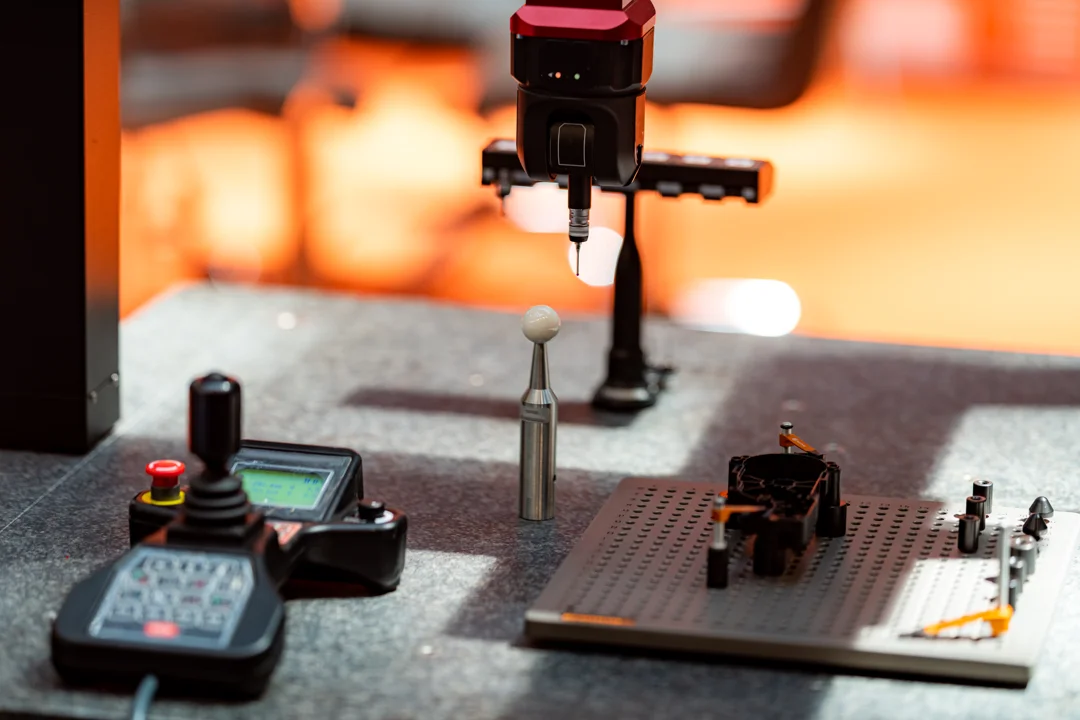
Prototyping only creates value if you can prove the part is right. That’s where our advanced metrology and inspection processes come in.
- CMMs & Surface Analysis: We use Coordinate Measuring Machines (CMMs) and surface finish analysis to verify every critical dimension.
- Detailed Inspection Reports: Our inspection documentation helps you isolate whether an issue is design-related or manufacturing-related.
- Faster Engineering Decisions: With precise data in hand, your team can iterate confidently, no guesswork, just progress.
We believe that prototyping without measurement is just guessing. Our inspection discipline is what turns a “part” into a validated prototype.
The Competitive Edge: Rapid Iteration Without Sacrificing Accuracy
Fast Feedback Loops
In research and development, speed is a competitive advantage, but only if you don’t sacrifice precision. Our rapid prototyping process is built for both.
A typical rapid iteration cycle at APM:
1. You send us your latest CAD revision.
2. We review it together, flagging any DFM (Design for Manufacturability) concerns.
3. Our machinists produce the prototype, often within days.
4. We inspect, document, and deliver the part to you.
5. You test, gather feedback, and send us your next iteration.
This tight feedback loop means you’re never waiting weeks for answers. We move at the speed of your innovation.
Collaboration in Action
The real speed in prototyping comes from collaboration, not just machine cycle time. Early conversations about intent, tolerances, interfaces, and critical surfaces can save days or even weeks down the line.
Pro Tip:
Before chips fly, let’s talk about:
- Thin walls and heat distortion
- Tool access and datum choices
- Fastener clearance and assembly order
Our job is to flag risks before they become headaches. We’re not just here to “make parts”, we’re here to help you get to the right part, faster.
Material Matters: Prototyping in Production-Like Materials
One of the biggest surprises teams face is when a prototype behaves differently than the final part. That’s why we recommend prototyping in materials that mimic production as closely as possible.
Our approach:
- Real-World Metals & Plastics: We prototype the same metals and performance plastics you’ll use in production, reducing surprises in strength, wear, heat, or chemical exposure.
- Material Guidance: Our team helps you select materials that balance function, cost, and manufacturability.
- Avoiding Pitfalls: We flag risks like galling, thermal expansion mismatch, or corrosion sensitivity before they become issues.
Here’s a quick reference for common materials and their scientific uses:
| Material | Common Uses | Key Properties |
|---|---|---|
| Stainless Steel | Biotech, Medical, Optics | Corrosion-resistant, strong |
| Aluminum | Aerospace, Lab Equipment | Lightweight, machinable |
| Titanium | Medical Implants, Aerospace | Biocompatible, strong |
| PEEK/Ultem | Electronics, Fluidics | Chemical-resistant, insulative |
Sometimes it’s smarter to prototype functionally first, then refine finish or cosmetic details later. We’ll help you make the right call.
Choosing the Right Machining Process for Your Prototype
Not every prototype needs the same process. Successful teams match the machining approach to their validation goal.
How we help you choose:
- CNC Milling: Best for functional prototypes with strength and tight tolerances.
- Wire EDM (Electrical Discharge Machining): Ideal for delicate features or hard materials.
- Hybrid Approaches: Sometimes, we’ll 3D print a rough shape and finish critical surfaces with CNC, compressing timelines without compromising precision.
Decision Tree Example:
- Need to test fit? Consider 3D printing or quick CNC.
- Need to test function or performance? Use production-like materials and full CNC.
- Need near-production? Combine processes for the best of both worlds.
We’ll walk you through the options and help you select the best path for your project.
Business Impact: Prototyping as a Growth Lever for Startups & R&D
For startups and R&D teams, time is money, and so is proof. Physical prototypes don’t just accelerate engineering; they accelerate business outcomes.
How prototypes drive your growth:
- Faster Demos: Lab-ready prototypes enable stakeholder demos and early field testing.
- Clearer Funding Conversations: Investors and decision-makers are more likely to say “yes” when they can see and touch your innovation.
- Earlier Adoption: Prototypes support customer feedback loops earlier in the development lifecycle.
We’ve seen clients go from napkin sketches to funded projects in record time, all because they could show, not just tell.

Cost-Effective Prototyping: Preventing Expensive Mistakes
Cost-effective prototyping isn’t about cutting corners, it’s about preventing expensive mistakes down the road.
Our philosophy:
- Strategic Investment: Spending on the right prototypes now means fewer redesign loops and scrapped parts later.
- Clear Tolerances & Inspection: Defining what’s “critical-to-function” keeps costs down and quality up.
- Smart Planning: Don’t overbuild, focus on what matters for this stage.
As we like to say, “Prototype smarter, so production is boring (in a good way).” Our goal is to make your ramp to production as smooth and predictable as possible.
Why Choose Advanced Precision Machining for Scientific Prototyping in Colorado?
When you choose APM, you’re choosing a partner who understands what’s at stake. We’ve grown from a small Colorado shop to a regional leader by focusing on what matters: reliability, quality, and real relationships.
What sets us apart:
- Full Lifecycle Support: From blueprinting and design through prototyping, inspection, and production.
- Local Expertise: Deep roots in Colorado’s scientific and tech communities.
- Proven Reliability: On-time delivery, ISO-compliant processes, and a track record of long-term partnerships.
- Modern Capabilities: State-of-the-art equipment, skilled machinists, and a passion for innovation.
But don’t just take our word for it. Here’s what one of our longtime clients shared:
“APM is more than a vendor, they’re a true partner. Their team caught design risks we hadn’t even considered, and their prototypes helped us secure critical funding. We couldn’t have launched without them.”
Ready to experience the APM difference? Schedule a consult or request a quote today. Let’s bring your next scientific breakthrough to life, right here in Colorado.

Frequently Asked Questions (FAQ)
- What’s the difference between scientific and commercial prototyping?
- How quickly can I get a prototype made in Colorado?
- What materials can be used for scientific prototyping?
- How does APM ensure quality and precision in every prototype?
- Can APM help scale my prototype to full production?
Scientific prototyping is about rigorous, data-driven validation and reproducibility, while commercial prototyping often focuses on usability and market readiness. We specialize in the former, helping you prove concepts under real-world conditions.
Timelines vary based on complexity, but many clients receive prototypes in days—not weeks. Early collaboration helps us move even faster.
We work with metals (stainless, aluminum, titanium), engineering plastics (PEEK, Ultem), and more. Our team will help you select the best fit for your needs.
Rigorous inspection, advanced metrology, and ISO-compliant processes are built into every project. Our machinists treat every prototype like it’s going to space, because sometimes, it is.
Absolutely. We designed our process to carry your project seamlessly from prototype to production, maintaining knowledge and consistency at every step.
by Gerry Dillon
Gerry Dillon is a co-founder, current owner and certified CNC machinist at Advanced Precision Machining (APM), a full-service machine shop located in Longmont, Colorado. Gerry has over 30 years of precision milling and machining experience under his belt.